

Firefighters have been monitoring the location to ensure the public stays away from the area.
PRU15: Kekal setia, cuma cara digugurkan itu yang terkilan – Mohd Salim
Mohd Salim tekad untuk terus berada dalam saf kepimpinan Barisan Nasional dan akan memberikan sokongan kepada calon baharu.
India’s Delhi shuts primary schools as air quality deteriorates
A reading under the severe category, or over 400, affects healthy people, with serious impacts on those with existing diseases.
PRU15: Halimah akur kehendak parti, ikrar akan terus sokong BN
Sebagai orang parti, Halimah berjiwa besar menerima keputusan dibuat pucuk pimpinan.
September 2022 Survey Highlights Handout
Poll Report

No coalition will win enough seats to form govt, poll shows
 themalaysianinsight.com | 04-Nov-2022 – NO one coalition will be able to win enough seats in the general election to form a federal government, the Merdeka Center for Opinion Research said today.
The independent pollster in its latest survey said that it was hard to predict the outcome of the the election with three big coalitions contesting 222 parliamentary seats.
“In our opinion, the presence of three significant coalitions with large bases of support as well as uncertainties on likely turnout rates makes it difficult to estimate the outcome in terms of projected number of parliamentary seats,” it said in a statement today.
The three coalitions are Barisan Nasional, Pakatan Harapan and Perikatan Nasional.
Merdeka Center said with a lower-than-expected level of Malay voter support for BN, it is possible that no single coalition will attain a large enough plurality to form a government.
The survey was conducted on October 19-28. it polled 1,209 respondents from West and East Malaysia aged 18 and above over the telephone.
The respondents were selected through random stratified sampling along the lines of ethnicity, gender, age and states.
It pegged the survey margin of error at 2.82%.
Merdeka Center said instead, there is a rising possibility that at least three or more parties or coalitions are needed to cooperate to form a government with a simple majority.
As for the country’s performance since early this year, the pollster said that a majority of 72% of the voters felt the country was headed in the wrong direction as opposed to only 20% who maintained that Malaysia remained on the right track.
This, it said, was a view that was prompted by concerns over the state of the economy, political uncertainty arising from the upcoming election and other topics such as corruption and inter-ethnic issues.
“Seventy-four per cent of voters feel that the economy is the country’s biggest problem at this moment.
“But voters’ own concerns were split across inflation (31%), political instability (13%), corruption (12%) and economic growth (12%).”
It said with respect to the ratings, the government’s approval rating presently stands at 31%, with 60% reporting dissatisfaction.
Meanwhile, the pollster said the approval rating for the caretaker prime minister (Ismail Sabri Yaakob) stood at 42%.”
The Election Commission has set Saturday as nomination. – November 3, 2022.
PN runner-up for Malay votes as support for BN declines
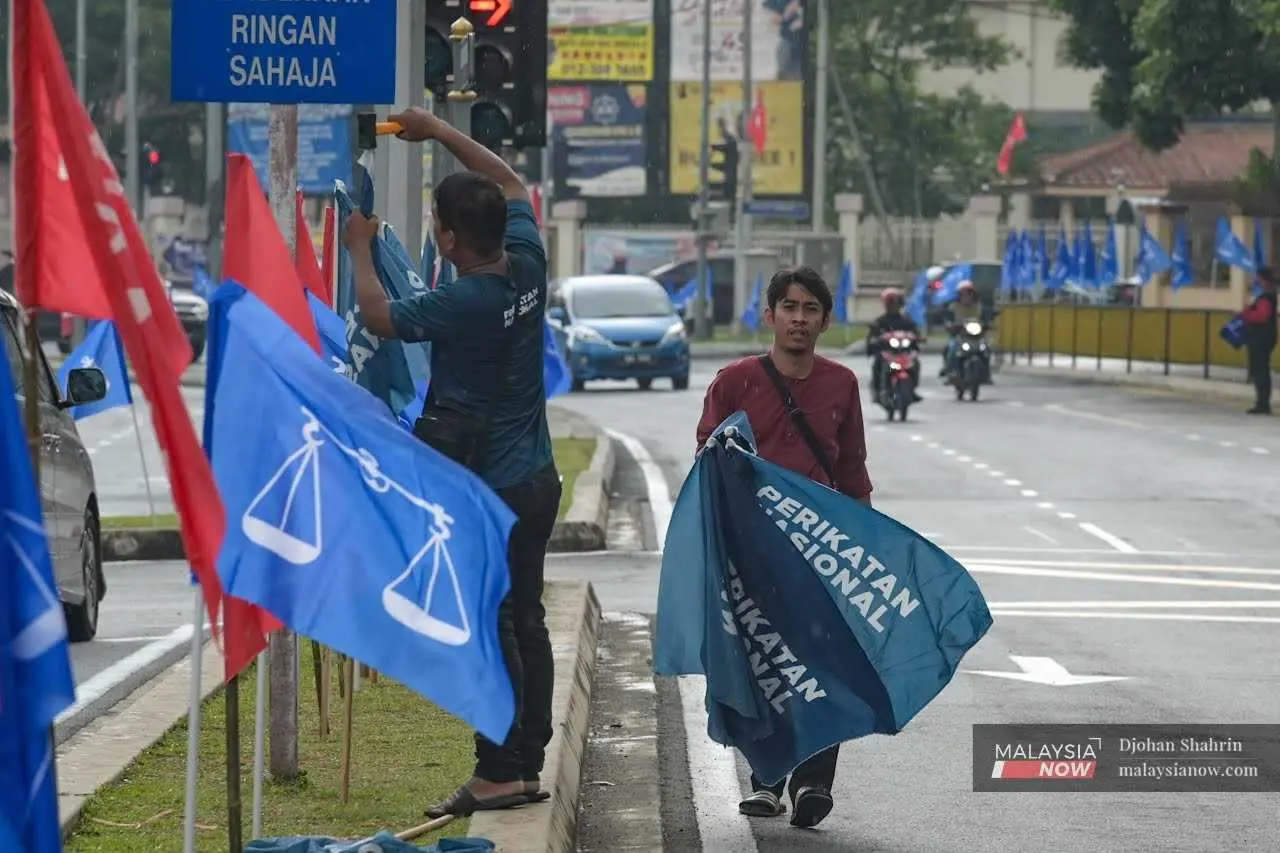
malaysianow.com | 04-Nov-2022 – However, nearly 30% of the Malay respondents polled indicated no preference or were undecided on their support
Perikatan Nasional (PN) has emerged as the runner-up in terms of Malay votes as support for Barisan Nasional (BN) dips, the latest pre-election survey by independent pollster Merdeka Center shows.
The survey, conducted from Oct 19 to 28 among 1,209 voters aged 18 and above, found Malay support for BN at 32%, followed by PN (20%), Pakatan Harapan (PH) (13%), and Gerakatan Tanah Air (GTA) and other pacts (2%).
A total of 29% said they had no preference or were unsure, while 4% did not respond.
Merdeka Center said the findings appeared to indicate a decline in overt preference among Malay voters for BN and a small increase towards PH.
“Yet at the same time, there remained as many as 29% of Malay voters who remarked that they had no preference or were still undecided,” it said.
“It is possible that some of these undecided voters may still vote in favour of the ruling party, but past experience tells us that the majority of them will likely go to either opposing party, i.e. PN and/or PH.”
Among the Indian voters, 32% indicated support for BN, 1% for PN, and 51% for PH. Some 6% were unsure and 2% said they had no preference for any party while 8% did not respond.
Among the Chinese voters, meanwhile, support for BN was at 5%, PN 1%, PH 47% and GTA 1%. A total of 23% said they were unsure and 18% indicated no preference while 3% refused to answer.
Across age groups, voters in the 18 to 20 bracket indicated 28% support for BN, 24% for PN, and 30% for PH. A total of 10% said they had no preference.
Those aged 21 to 40 indicated 21% support for BN, 14% for PN and 26% for PH, while voters over the age of 40 marked 27% support for BN, 10% for PN and 24% for PH.
For both these age brackets, 16% said they had no preference for political party.
The majority of voters – 72% – said the country was headed in the wrong direction while 20% said Malaysia remained on the right track.
Concerns included the state of the economy, political uncertainty due to the upcoming election, and other issues such as corruption and race.
A total of 74% said the economy was the biggest problem at the moment while other concerns ranged from inflation (31%) to political instability (13%), corruption (12%) and economic growth (12%).
The approval rating for the federal government stood at 31% with 60% indicating dissatisfaction, while the approval rating for the caretaker prime minister was at 42%.
In terms of factors behind voting choices, 31% said they were focused on local candidates followed by party (21%) and national leadership (13%).
First time voters aged 18 to 20 were twice as likely to look at national leadership (24%) than the rest of the electorate.
Regarding candidate characteristics, the top desirable features were “someone with good ideas for the country” (27%), “clean and trustworthy” (24%) and “able to bring development to the area” (13%).
Younger voters placed more emphasis on “clean and trustworthy” (34%) and less on the candidate’s ability to “bring development” (4%).
“In our opinion, the presence of three significant coalitions with large bases of support as well as uncertainties on likely turnout rates make it difficult to estimate the outcome in terms of projected number of parliamentary seats,” Merdeka Center said.
“At this point in time, with the lower-than-expected level of Malay voter support for BN, it is possible to imagine that no single coalition will attain a large enough plurality to form a government with just one other party or coalition.
“Instead, there is a rising possibility that at least three or more parties/coalitions are needed to cooperate to form a government with a simple majority.”
The racial demographics of the survey were Malay (52%), Chinese (29%), Indian (7%), Muslim Bumiputera (6%) and non-Muslim Bumiputera from Sabah and Sarawak (6%).
Respondents were selected randomly and from each of the country’s 222 parliamentary constituencies.

Rival Malaysia parties need to form alliances to win election, poll shows
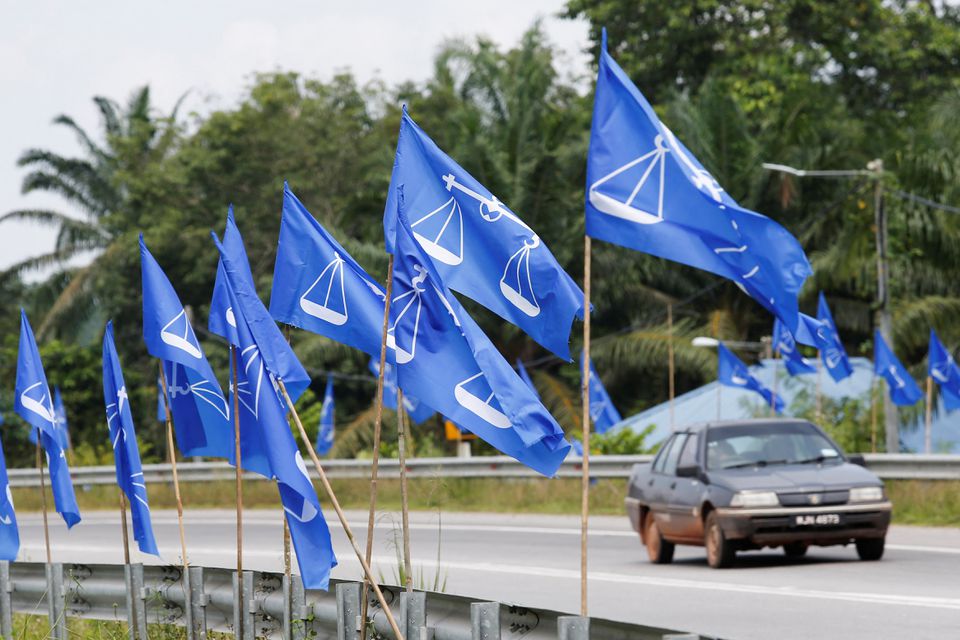 reuters.com | KUALA LUMPUR, Nov 4 (Reuters) – Malaysia’s opposing political blocs will need to form an alliance to stand a chance of governing after this month’s general election, with none likely to win a simple majority, an opinion poll showed on Friday.
There are 21 million Malaysians eligible to vote on Nov. 19, with opposition leaders Mahathir Mohamad and Anwar Ibrahim, and former premier Muhyiddin Yassin competing to unseat a government led by Prime Minister Ismail Sabri’s Barisan Nasional.
The Merdeka Center’s Oct 19-28 survey of 1,209 people showed 24% of voters preferred Barisan, while 26% favoured Anwar’s main opposition bloc Pakatan Harapan. Nearly a third – or 31% – were undecided or had no preference.
About 13% supported Muhyiddin’s opposition bloc, while 2% favoured former premier Mahathir’s newly-formed alliance.
Since the last election in 2018, Malaysia has had three prime ministers as parties governed with razor-thin and unstable majorities.
Barisan lost for the first time in Malaysian history in 2018 following a multi-billion-dollar scandal at state investment fund 1MDB that plagued its ruling UMNO party, which prioritises interests of the ethnic-Malay majority.
Barisan is seeing lower than expected support among Malays and has not gained significant ground since 2018, Merdeka Center said. The poll showed the economy and inflation were top concerns of respondents, ahead of political instability and corruption.